Imagine you’re on a fast-moving DeFi trade: an arbitrage window opened, liquidity is thin, and you’re about to sign a multi-step transaction that touches three chains and two lending protocols. In the browser extension you trust, a confirmation pops up. Do you sign, or pause to parse a blob of raw calldata? For many power users the difference between profit and loss, or between safety and a drained wallet, comes down to how well your wallet prevents blind signing and explains what a transaction will actually do.
This article examines Rabby Wallet through that practical lens: how its transaction simulation, pre‑transaction risk scanning, and multi‑chain ergonomics work together to reduce operational risk for active DeFi users in the US market. I’ll explain the mechanisms behind simulation and approvals, compare Rabby to sensible alternatives, point out where the protections stop, and give clear heuristics to decide when Rabby’s model helps you — and when you still need additional controls.
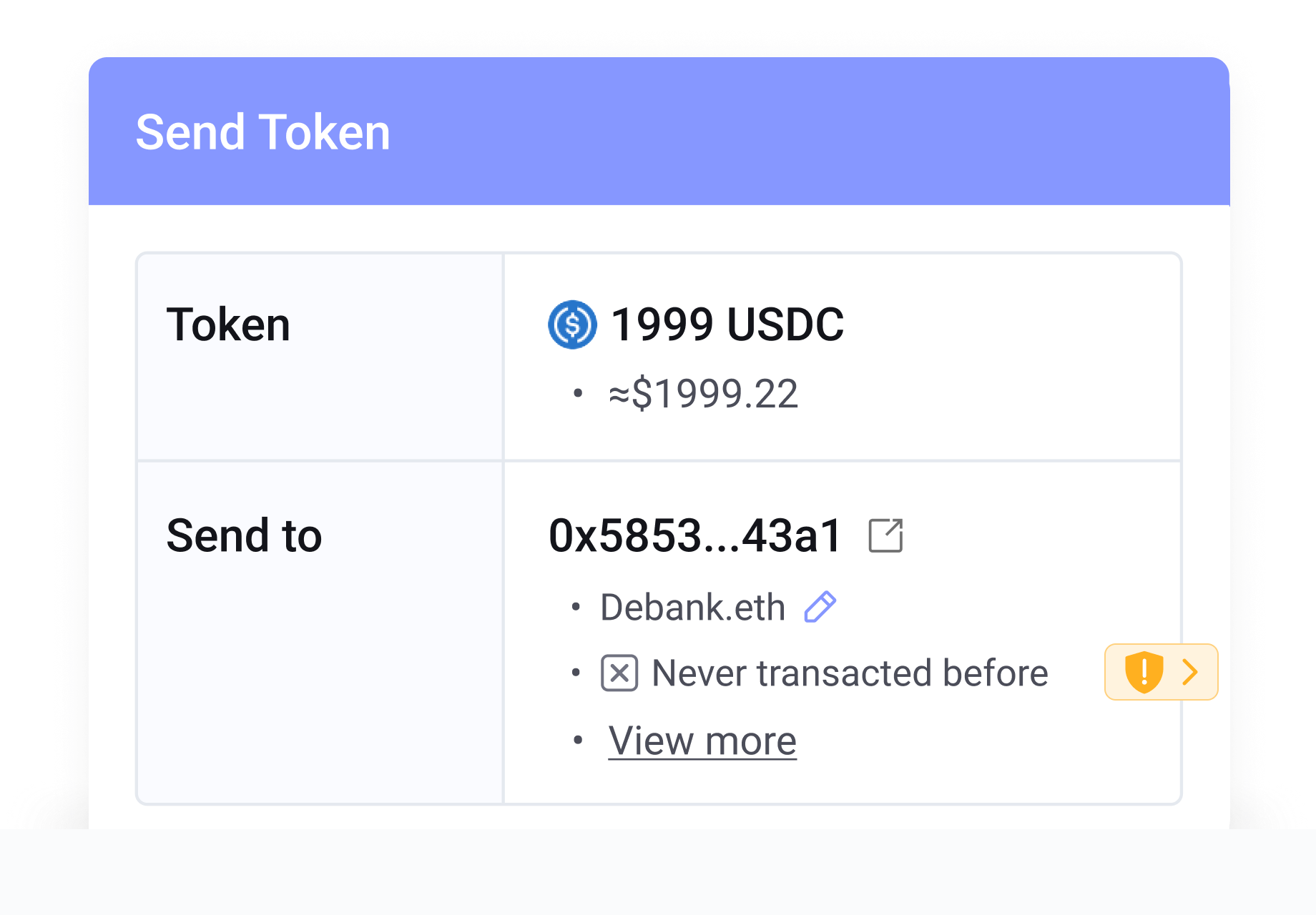
How transaction simulation works, and why it matters
Transaction simulation is a pre‑signing run of your intended operation against a node or local EVM sandbox that returns the expected state changes without broadcasting the transaction. Mechanically, Rabby takes the call data you would sign, simulates execution on the target chain, and shows the user estimated token balance changes and gas costs. This is different from static heuristics: it runs the actual code path (as best as a node can emulate) and reports an outcome the user can inspect.
Why this matters: many hacks and costly errors come from “blind signing” — users approving or executing transactions without knowing the concrete asset flow. Simulation converts an opaque calldata blob into a readable change in token balances. For active DeFi traders who sign complex multicalls or route trades through aggregators and custom contracts, that surface-level preview can prevent accidental approvals of malicious tokens, unintended approvals that grant infinite allowances, or operations that would leave you short on gas.
Rabby’s layered security model: simulation plus scanning
Rabby bundles simulation with a pre‑transaction risk scanner that flags previously hacked contracts, suspicious approval requests, or non‑existent recipients. In practice this creates two layers: a deterministic “what will happen” model from the simulation, and a heuristic “is this counterparty or request risky?” model from the scanner. Layering matters because simulation can’t tell you whether a counterparty is malicious — it only shows outcomes. The scanner brings contextual threat intelligence to the output, which is useful when an on‑chain simulation shows token flows to an unknown contract.
Institutional and power users get an extra lane: Rabby integrates with multi‑sig and enterprise custody providers (Gnosis Safe, Fireblocks, Amber, Cobo). That allows teams to keep the same simulation and revoke workflows while adding governance controls. For a US DAO or trading shop, that combination reduces single‑operator risk without breaking compatibility with widely used custody tools.
Where Rabby stands among practical alternatives
Compare three common choices: MetaMask, Trust Wallet (mobile‑oriented), and Rabby. MetaMask is ubiquitous and well‑understood, but historically it leaves the burden of interpreting calldata on the user. Trust Wallet focuses on mobile ease but lacks Rabby’s desktop browser-centric tooling and deep pre‑transaction scanning. Rabby differentiates by combining automatic network switching, broad hardware wallet support, and explicit simulation that shows token balance deltas before confirmation. For a DeFi power user who executes complex multicalls, that combination reduces cognitive load and helps avoid a class of human errors.
Trade-offs: Rabby’s feature set leans security-first for active DeFi interaction, which means it doesn’t try to be everything. It lacks a native fiat on‑ramp and in‑wallet staking features; if you want seamless on‑ramp or staking primitives inside your wallet UI you’ll need supplemental tooling. Also, simulation increases latency and requires reliable node responses — in volatile moments the preview may reflect a slightly different state once the tx is mined, especially on congested networks.
Limits and realistic failure modes
Simulation reduces risk, but it isn’t a silver bullet. First, simulations run against a node snapshot and cannot perfectly predict outcomes that depend on rapid front‑running, mempool reordering (MEV), oracle updates between simulation and execution, or off‑chain access controls enforced at execution. Second, the scanner relies on known threat intelligence: it flags contracts seen in hacks, suspicious patterns, or malformed addresses, but it won’t flag novel, well‑crafted malicious contracts that behave benignly in simulation and only exploit users through social engineering or later upgrades.
Historical context matters: Rabby’s team froze and compensated users after a 2022 exploit related to Rabby Swap and increased their audits afterwards. That demonstrates both that security issues can happen in even well‑audited ecosystems and that active incident response and transparency are meaningful mitigation behaviors. For US institutions, that history is instructive: an audited, open‑source codebase and a responsive team lower but do not eliminate systemic risk.
Operational heuristics: when to trust the simulation, when to add layers
Here are practical rules I use when managing a hot wallet for DeFi operations:
– For routine swaps on well‑known DEXs and ERC‑20 approvals under a modest allowance, Rabby’s simulation plus the approval revocation tool is usually sufficient; it reduces accidental infinite approvals and shows the expected slippage and fees.
– For complex multicalls, cross‑chain hops, or contracts you haven’t audited, require an additional human review step. Use Rabby’s simulation to get a balanced view, but gate final signing behind a second device or a hardware wallet to avoid remote key exfiltration risks.
– For institutional flows that move large sums, combine Rabby’s multi‑sig integrations and hardware wallet connection. Treat simulation as a pre‑execution audit output, not a last line of defense; keep a checklist that includes counterparty reputation, contract source verification, and whether oracles used by the contract could be manipulated in the tx window.
Practical takeaway and what to watch next
Rabby’s transaction simulation reforms a simple but dangerous habit: signing without understanding consequences. For DeFi power users in the US, the primary benefit is decision clarity — a readable preview of token deltas and fees reduces accidental exposure. But simulation’s accuracy depends on fast, reliable node responses and cannot defend against MEV, oracle manipulation, or novel smart‑contract backdoors that mimic benign behavior.
What to watch next: adoption of on‑chain formal verification outputs integrated into wallet UIs could tighten the security loop. Also watch how wallets surface mempool risk indicators (e.g., expected sandwiching likelihood) and whether simulation tools begin to offer probabilistic ranges tied to current mempool conditions. If those signals arrive, the predictive value of pre‑signing previews will improve; until then, simulation is a powerful but partial defense.
If you want a closer look at Rabby’s feature set, integrations, and supported platforms, see the project overview here: https://sites.google.com/cryptowalletextensionus.com/rabby-wallet/
FAQ
Q: Does Rabby’s simulation protect me from front‑running and MEV?
A: No — simulation shows the expected state change at the moment you ask, but it cannot prevent third parties from inserting transactions between simulation and execution. Simulation helps you spot suspicious intents and unexpected balance transfers, but to mitigate MEV you need additional tooling (private relays, transaction bundlers, or priority gas controls) and operational practices like splitting orders or using limit orders on DEXs that support them.
Q: Can I use Rabby with a hardware wallet and multi‑sig at the same time?
A: Yes. Rabby supports Ledger, Trezor, and several other hardware wallets, and integrates with multi‑sig and enterprise custody solutions like Gnosis Safe and Fireblocks. Combining these reduces single‑point‑of‑failure risk: the simulation guides decision making, while hardware keys and multi‑sig enforce execution controls.
Q: Will simulation always show exact gas costs?
A: Simulation estimates gas based on current network conditions; it reports expected fees, but actual gas used can vary due to on‑chain state changes between simulation and mining. Treat the gas estimate as a close guide, not a guarantee—monitor live fees and consider adding a small buffer when submitting transactions.
Q: If I see a contract flagged as ‘previously hacked’, should I never interact with it?
A: A flag is a serious warning but not an absolute ban. Contracts may be forks, re‑deployments, or recovered projects. Use the flag as a trigger to conduct deeper checks: review contract source, ownership, timelocks, and community signals. For high‑value operations, prefer audited, widely used contracts and consider using an intermediary or multi‑sig approval path.